
Lesson 2
Overview
Lesson 2.1
Designing Your Playscape Bases .
In this section, you’ll begin designing your OWN playscape.
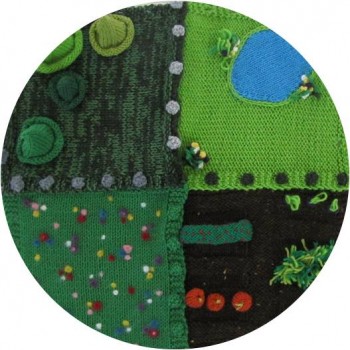
I’ve included 4 BASE squares, each demonstrating a different stitch. They are designed to teach you basic techniques & give you an opportunity to learn (or review) the various steps in a simple knit project.
Throughout this course, you’ll be exploring how to personalize your project. The connectors gave you a little room to try your hand at choosing colours. These squares will open up the creative field just a bit more.
Here you can choose your colours, which texture you want with which colour & whether or not you’d like to add a completely different stitch or texture. Of course, you can also add more squares too – but you might want to wait until you’ve finished other aspects of the project first!
There are 2 ways to approach this lesson….
. If you like the squares in this lesson – great! Just watch each video, download the pattern & get knitting. . If you want to make some changes– great! There are just 3 “rules” you should follow to ensure success… .
Make sure that every square:
- is 12” or 30 cm square
- has buttonholes in the right places to match the layout of the connector buttons
- has a garter stitch border
Keep in mind that these bases are intentionally plain, this way they’ll create versatile backdrops for your stories!
It will take you a while to knit all 4 squares. That’s OK! Just keep on watching & reading the next lessons, as you might want to use some of your square- knitting time to brainstorm ideas for your building, garden, animals & people! .
To Start Designing your Bases –
- Print out the “Playscape Bases” design sheet a few times
- Get your yarn tags, crayons, paints or pencil crayons out
- Try a few colour/texture combos
- Print out the Guide To Mixing Yarns & try combining yarns
** NOTE ** If you are planning to make the squares exactly as shown, still take the time to colour in your connectors & bases on the Playscape Component sheet ( from Lesson 1). This will be helpful when you’re designing other elements of the project. Check out the Gallery for this lesson to see more images.
Playscape Bases Design Sheet
Guide To Mixing Yarns
Lesson 2.2
Practice & Patience
. In this section, we’ll take some time to consider simple ways to deepen our knitting experience. I believe that children can sense if you are enjoying your knitting. If they see you knitting (outside of when you’re trying to teach them to knit), they will come to understand that knitting can mean a lot more than just a way to make something with yarn! .
Practicing Knitting
If you’re just learning to knit, then you will definitely need to do some practicing. I’d like to suggest that you do it when the kids aren’t around…. you don’t need an audience when you’re just starting out!
If you make the effort to knit a few practice pieces (mine are only 15 – 20 stitches wide – they’re supposed to be small), you’ll be glad that you did.
Try knitting the 4 button connector to get some experience with the stocking stitch or experiment with the slip stitch to see how often you want to slip your stitches. Keep them or not, it’s up to you. It’s doing the work that counts.
Try to think about how you feel while you’re in the early stages of knitting. Many of these same thoughts & emotions will come up for your child when he begins. (I’ll talk more about how & when your child should practice in a later lesson).
If you’re already a knitter, set yourself a small bit of homework – try to learn a new stitch that you find daunting. That will give you an opportunity to feel a mixture of uncertainty, frustration & hopefully, enjoyment & pride once you accomplish your task.
Keep track of these emotions so they’re fresh in your mind when you’re teaching your child. .
Creating a Knitting Practice
The idea of creating a knitting practice is really for you – of course, you can bring elements of it to your child but she probably won’t get “into” it in the same way that you might. I’ve often read about the marvelous benefits of meditation but find myself wondering how I could fit it into my already full days. You can imagine how excited I was when I recently discovered that knitting can induce a similar state in your brain & slow your body rhythms just like more traditional meditation techniques! .
You’ll find 3 exercises in this section.
The Draw A Knit Stitch challenge
Pop over to the Gallery & check out the exploded knit stitches I created & then try to use them as inspiration while you draw a few rows of knitting.
I guarantee you it is WAY harder than you think!
Go slow & start with just drawing the first row & then try 2 & then 3 rows. It’s a great way to prepare for knitting or relax, you can NOT think of anything else while doing this, seriously!
If your child is older, you might want to let her try it. It would make an amazing form drawing.
The Practice Prompts Sheet & Knitting Log
Both of these are optional but give them a try for a week or 2 – just for fun.
Choose a prompt each time you begin a practice session & see what comes up – jot a few notes or sketch your thoughts in your KnitNotes Ideabook while you knit or afterwards.
The Knitting Log is something I’ve wanted to try for a long time. It might seem a bit too analytical at first but it doesn’t have to be. See if the prompt you’ve chosen changes the way you feel during your time, does your knitting look different?
Does where you are affect how you more than you thought it would ?
Knit & Explore!
.
Knitting Practice Prompts
4 Button Connector Pattern
Drawing the Knit Stitch
Lesson 2.3
How to Knit Your Playscape Bases
. Here are 4 videos demonstrating the various techniques you will use to knit your playscape bases. The written patterns are below the videos. Please print them & keep them in your KnitNotes Ideabook. .
In this section of Lesson 2, we’ll cover the following techniques:
- Basic Yarn-Over Buttonhole
- Garter Stitch Border
- Purl Stitch
- Stocking (or Stockinette) Stitch
- Using Stitch Markers
- Knit Welts
- Using a Row Counter
- Working with 2 Strands of Yarn Together
- Slip Stitch
.
Tips for Watching the Technique Videos
.
- Before you watch each video – make sure you have your KnitNotes Ideabook on hand so that you can make notes &/ or sketches for yourself.
- Each video builds upon the last. You should be comfortable with one technique before you move onto the next.
- If you have never worked with 2 strands of yarn held together (to form a heavier weight yarn) then watch the Slip Stitch Video BEFORE you begin your Garter Stitch Playscape Base. .
If you are a BRAND NEW knitter :
- If you don’t know how to knit at all – then watch the videos at least twice before you take up your needles & yarn.
- Then try to work along with the video- pausing (or rewinding) as often as you need.
- Make note of the questions that come to mind as you’re watching /knitting.
- Every question is valuable & it’s important that you’ve thought through your answer BEFORE your child asks it! .
.
If you are a knitter already:
- Watch the videos & take notes too – pretend you have never knit before – what points do you think would be important for you to pass on to your child as he tries knitting for the first time ?
- Are there areas where you think he might be challenged?
- Remember, there are many tiny movements & adjustments that you naturally make with your hands as a knitter. You have to take inventory of them & be prepared to be able to explain exactly WHAT you do while you knit!
- Be prepared!
. VISIT the Gallery to see close up pictures of the various playscape bases.
Garter Stitch Square Pattern
Stocking Stitch Square Pattern
Knit Welt Square Pattern
Slip Stitch Square Pattern
Lesson 2.4
Your Container Story
Setting the Stage
Coming Next!